MEET THE COMPANY: NICOLA KILMURRY
Ballet Ireland’s company dancer Nicola Kilmurry on the step she used to dread, training the basics, and what to watch if you’ve never attended a ballet before.
When Nicola Kilmurry joined Ballet Ireland three years ago, the one step she dreaded the most were fouettés en pointe. And then she was required to perform exactly that during an Arthur Pita trio for A Dream Within a Midsummer Night’s Dream. Her hard work paid off: “The rest of the company cheered me on from the wings and on stage as they all knew what a challenge this was for me.” A month solid of near-daily practice, never taking class in flat shoes, and she stuck the landing every performance. A dancer’s job is to make the impossible look easy and effortless, even while an audience simply sees a beautiful performance. They don’t see the difficult work behind-the-scenes, the hours and days spent perfecting a single step.
BORN IN DUBLIN
Nicola began dancing at age 10, and studied directly with Nicola Farcas at The Nicola Farcas School of Ballet. She later joined the Irish National Youth Ballet Company, where she trained and performed with them for four years. In 2020, she was invited to continue her training at Central School of Ballet in London.
Leaving Ireland felt inevitable for her career. “I always thought that once I left Ireland to study, I probably wouldn’t come back home to work as a dancer.” In London, she worked with The Ashton Foundation and Michael Pink, performing Monotones I by Frederick Ashton, Mirror Mirror by Michael Pink, and Dextera by Sophie Laplane on the 2023 Ballet Central Tour. That same year, she returned home to join Ballet Ireland, performing in Carmen, Nutcracker Sweeties, Cinderella, and Bold Moves: Dare to Dream. “I’m glad that I ended up coming back to Ireland and I have so many work opportunities that I didn’t think I’d be able to have at home.”
STUDYING BALLET AS A VOCATION IS NOT JUST ABOUT BEAUTIFUL TUTUS AND TURNS
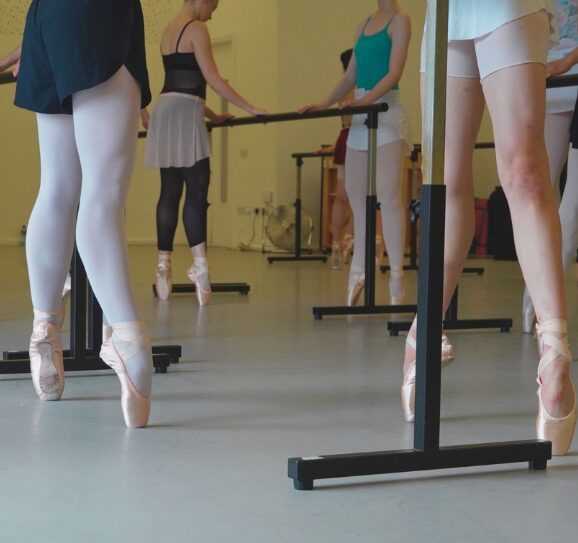
Nicola remembers spending months in her first year vocational training practicing the most basic exercises at the barre and in the centre to focus on not simply the steps, but the body: pelvis placement and turnout. “At the time I just wanted to do all the super hard stuff, but now I know that I wouldn’t be able to do any of that without going back to basics first.” It’s her history of studying those basics that highlighted to her the importance of daily discipline, and that made a month of practicing fouettés en pointe possible.
You may have seen Nicola as Winifred, one of the stepsisters in last year’s production of Cinderella. It’s a comedic role in a recognizable story that was fun to perform for the audience because it’s readable. But something more modern like the Pita, with no familiar story for the audience to lean on, is a unique challenge. “Without that clear story, it’s hard to get the storytelling correct and believable with only the use of dance,” she says. “It’s the choreography that portrays the storytelling through actions and movement, and it’s up to the dancers to add the artistic performance under the choreographer’s guidance.” Two men fighting over one woman for her love in A Dream Within a Midsummer Night’s Dream (Bold Moves: 2026) is clearer to convey than King Arthur’s difficult relationship with his three daughters in Storm Scene, both by Arthur Pita.
When working with a new-to-her choreographer, she hopes for a calm room with rehearsals that are enjoyable, and with someone who understands that absorbing choreography takes time. Dancing is most enjoyable for her when she simply gets to dance. “I don’t perform my best when I feel I have to prove myself,” she says of the casting process. “My best attributes lie in my musicality, artistic performance and retention of the choreography, counts, and music cues, which isn’t always noticed in the beginning of the rehearsal process.”
HER ADVICE ON WHAT TO LOOK FOR IF YOU’RE NEW TO WATCHING BALLET?
“Look at the upper body and the faces. Even as a dancer myself, I don’t always look at the legs and feet, as those are always expected to be great when seeing a professional performance. The use of the upper body and facial expression are always what portray the story of the ballet best. I always think that the storytelling is the most important part of being a dancer. A small mistake can be forgotten, but the emotions that the dancers make you feel will stay with you even after you leave the theatre.”
With rehearsals for the autumn tour about to begin, we were curious as to what’s in her dance bag that has nothing to do with dancing: “I always carry tissues, lip balm, and multiple different perfumes and body sprays. I also always have many different types of drinks and juices, just for enjoyment!”
There’s much to enjoy about life as a professional dancer, but “it isn’t as dramatized as TV shows or movies make it out to be. Especially here at Ballet Ireland, the environment is not intensely competitive, and almost feels like a second family to me.”

You can see Nicola Kilmurry perform with us this autumn. Be sure to cheer her on for every fouetté.